Appendix 11 — Considerations on Rotation
Appendix 11.1 — Introduction
In this appendix we provide an explanation of centrifugal and centripetal forces, first based on classical Newtonian mechanics, and later extending this to general relativity.
The centrifugal force is the apparent force acting outward from the center of rotation. The centripetal force is the real force directed toward the center and required to keep a particle in circular motion.
Appendix 11.2 — Momentum
According to Newton, a moving particle with mass \(m\) and velocity \(v\) has momentum:
If no forces act on the particle, it moves uniformly in a straight line. Relative to a point at distance \(r\), the particle has angular momentum:
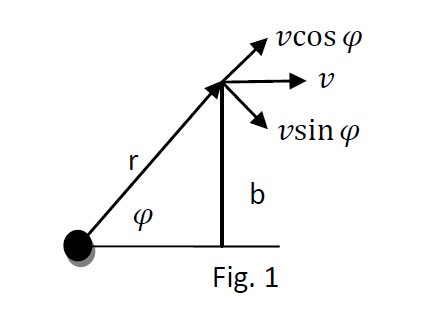
In the figure above, the angular momentum is:
where \(b = r\sin\varphi\) is the perpendicular distance between the particle’s trajectory and the reference point.
Appendix 11.3 — Circular Motion
As stated earlier, a particle moves uniformly in a straight line if no force acts on it. Thus, if the trajectory is circular, a force must be present: the centripetal force.
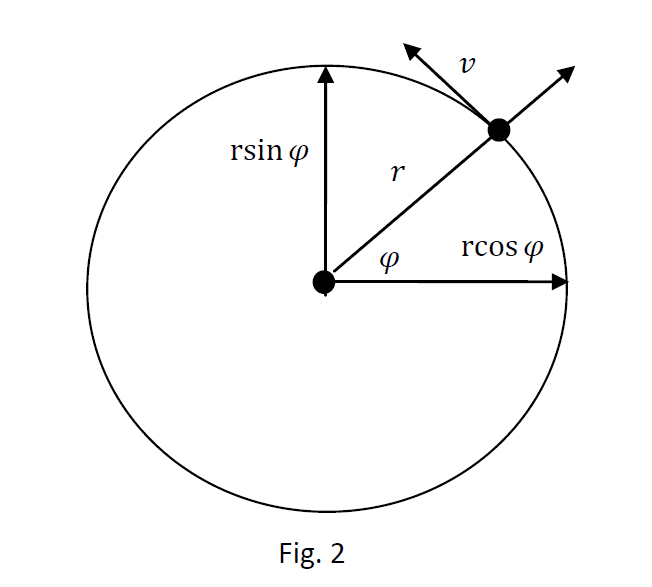
We start with a constant radius \(r\) and decompose the motion into x and y components. The position as a function of time is:
where \(\omega\) is the angular velocity.
Velocities
Accelerations
The total acceleration is:
Since both components are negative (directed toward the center), the vector acceleration is:
Force
The total force acting on the particle is:
The magnitude of the force is:
Interpretation
According to inertia, the particle tends to move in a straight line. However, circular motion gives rise to an outward apparent force (centrifugal in the rotating frame):
To keep the particle in circular motion, this must be exactly balanced by an inward force:
This centripetal force maintains the circular trajectory.
Appendix 11.4 — Rotation of a Sphere
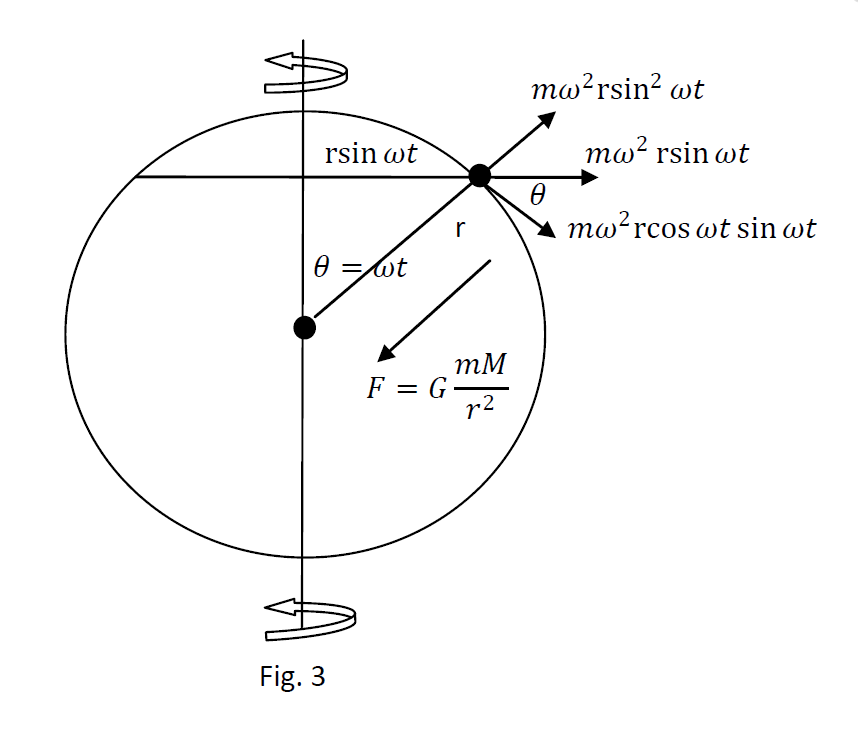
Together with the centripetal force, this results in the following force on a particle on a rotating sphere:
In addition, there is a tangential force directed toward the equator:
Particles therefore experience a force component toward the equator, causing the sphere to deform into an ellipsoid. The distance from the center to the surface is smallest at the poles and largest at the equator. As a result, gravity varies with location.
Gravity also depends on the enclosed mass. Since the distance to the center is smaller at the poles, the enclosed mass there is smaller. Gravity increases due to the shorter distance, but decreases due to the smaller enclosed mass.
The final shape is an ellipsoid in which these effects are in equilibrium. See also: Newtonian Gravity — Rotating Bodies .
Appendix 11.5 Relationship Between Angular Momentum and Energy
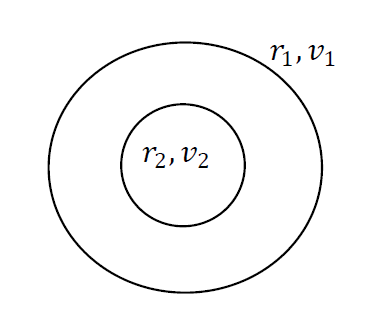
Difference in kinetic energy between two circular orbits
For a particle moving from a circle with radius \(r_{1}\) to a circle with radius \(r_{2}\), the difference in kinetic energy is:
The angular momentum is constant:
Substituting (\ref{eq:R17}) into (\ref{eq:R16}):
Work done by the centripetal force
The centripetal force is:
The minus sign indicates that the force is directed inward. The work performed by this force when the particle moves from \(r_{1}\) to \(r_{2}\) is:
This work must be equal to the difference in kinetic energy:
This establishes the connection between the change in kinetic energy and the work of the centripetal force.
The angular momentum is constant:
Thus:
The work performed by the centripetal force between \(r_{1}\) and \(r_{2}\) is:
Substitute \(v = \frac{\text{Const}}{m r}\):
This gives:
Since:
Thus:
We see that equations (\ref{eq:R18}) and (\ref{eq:R29}) are identical, thus:
This confirms that the difference in kinetic energy exactly equals the work done by the centripetal force — a crucial step toward the effective potential in central force fields.